
on aphids
and making different animals from the same genes

Dunedin, where I live and work, is a weird little place. The weather can be atrocious. This year, I am not sure that summer came at all. The term ‘dreich’ was invented for Dunedin. But then there are days, often in late Autumn, when the sky is clear, the air still, and Dunedin fills with a golden light that highlights the yellow and red falling leaves from the confused Northern Hemisphere trees. It’s days like these that make you understand why the Otago colours are gold and blue. The blue of a clear sky and the gold of the sublime light. The residents of the town, blinking in the strong light and lack of drizzle, sit outside the city’s cafes sipping their flat whites and shivering, hoping that the weather might last the day.
Such days, especially when it is still, fill the air with tiny flying insects, most of them aphids. You can catch sight of them as you look towards the sun, as they glow in the golden light, as they cluster around the trees and shrubs they are hoping will provide a place for their eggs.
If you ask any gardener, Aphids suck, but I want to tell you that there is much more to your average Aphid. Aphids are hemipteran insects (which also sort of means they suck), and hemimetabolous. Hemimetabolous is a fancy way of saying that they don’t have a larval stage. Holometabolous insects, like butterflies, lay eggs that hatch into larvae (caterpillars), which eat things. These pupate and transform into adults. Hemimetabolous insects, such as aphids and crickets, cockroaches and lice, lay eggs that hatch into little versions of the adult, which then moult and get bigger. Aphids lay eggs that hatch into smaller aphids- but not all the time. Sometimes they lay little adults, no eggs at all.
Aphids are plant suckers. They stick their needle-like mouthparts into plants and suck hard, collecting sugar and protein from the sap. Because of this, they are intensely affected by the season. In winter, there are slim pickings for Aphids, and so they make it through the dark days of winter as hibernating eggs. In spring, those eggs develop and hatch into new aphids.
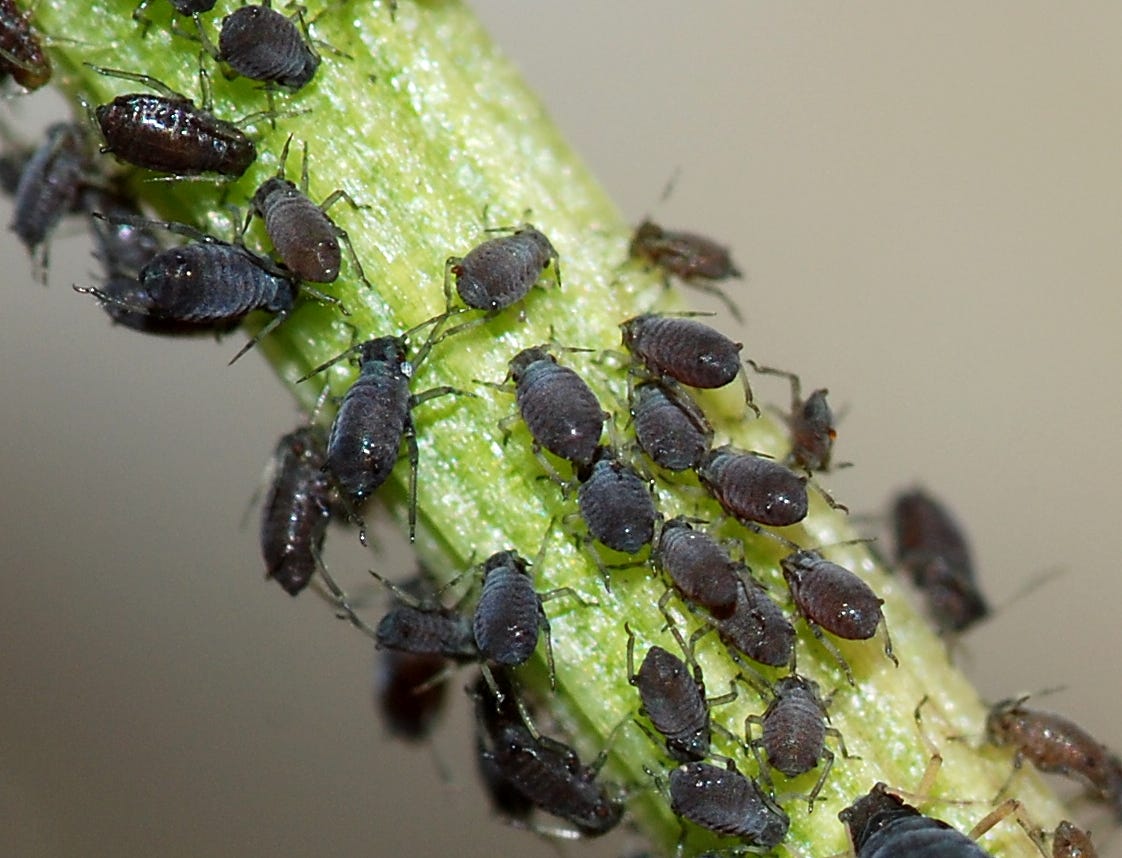
This seasonality clearly has presented a problem for Aphids because they have evolved, several times, a clever way to solve it. In spring, populations are low, and the season is short. Aphids need to make the most of the available resources to produce new offspring and colonise the area their mothers had laid them in the previous season. What they don’t have time for is sex. The whole messy business of finding a mate and fertilising eggs is too much hassle. The aphids, all of them female, that hatch from winter eggs have retooled their ovaries and instead of laying eggs, lay nymphs; little versions of themselves. Instead of waiting around for a passing male, they do without them and lay thousands of tiny nymphs parthenogenetically.
Even cooler than this, the nymphs they lay are already pregnant with the next generation of nymphs, and some of those next generation are already pregnant with the next. So the solo aphid, having survived winter, rapidly builds up a population of clones that exploit the neighbourhood. This is why gardeners and greenhouse enthusiasts hate them. Get one in your plants, and soon you have generations sucking away at the sap.
If you look closely at the little clones of aphids on your greenhouse plants, you might notice they have no wings. The new aphids don’t bother; they don’t need to move, they are happy where they are. If the neighbourhood isn’t welcoming, then something signals to the next generation of embryos, which then are born with wings, can disperse, and go and make new clones elsewhere.
As winter approaches again, something changes in the aphids, and both females and males begin to be born. These have wings, and the females have a different sort of ovary- one that produces eggs. It’s these that we see on those late summer days, flying to find a mate and a safe place to lay eggs to start the whole process over again.
All very fun, and annoying for plant growers. But this is where I get interested. The difference in behaviour, form and reproductive mode is called a polyphenism. Polyphenisms are strange things that happen in a few animals that allow them to produce two different forms from one genome. You already know about these because you know about queen and worker bees. Queens and workers are both female bees, but Queens are transformed into quite different animals by being fed royal jelly. Diet, in the case of bees, triggers some change in development that leads to the queen form. In aphids, there are two polyphenisms, the reproductive one and the wing one.
I am very interested in polyphenisms because I study the way embryos evolve to give different forms of animals. I try to understand how evolution shapes the way genetics makes an animal, to make different shapes and forms. Polyphenisms are fascinating because they can make those differences in shape and form with no genetic change at all.
The wing polyphenism in aphids is cool, but I am really fascinated by the reproductive one. When we look at the two different sorts of embryos, eggs and nymphs, they are completely different. Beyond that, the ovary looks different. So aphids contain in their genomes- their genetic code- instructions for two completely different sorts of embryos. How they do that is we are still trying to find out.
Also fascinating is how these polyphenisms are triggered. The wing polyphenism seems most likely to be triggered by crowding. Too many aphids make some trigger their offspring to grow wings, which then head off into the unknown. The reproduction polyphenism seems to be triggered by day length. As the days get shorter, the aphids begin to switch reproductive modes.
One feature of polyphenisms is that they seem to involve hormone signalling systems. Something triggers the polyphenism, stuff happens that we don’t really understand, and this leads to the release of a hormone that seems to trigger all the coordinated changes required. So for the winged phenotypes, a hormone ensures that there are wings, flight muscles, and the metabolism required to operate wings effectively.
Polyphenisms drive home the point that you don’t need new genes to make new morphologies or forms. You can make two different forms of wings, or two different sorts of reproductive structures, or queens vs worker bees, without any genetic change. It’s not what genes you have, it’s how you use them. If you want to know more about the mechanisms of polyphenisms, you could try here1.
On those glorious days when the sky of Dunedin is full of aphids, I am thrilled by the idea that all those tiny beating aphid wings are the result of a complex and poorly understood process that helps us figure out how the processes of making an animal are flexible enough to produce very different forms in different environments.
For those of you trying to get rid of your aphids, try ladybirds, spraying soapy water, or (my favourite) breathing on them. The CO2 in your breath overwhelms them, and they shower off the plant. You will need to find some way to stop them from crawling back up. The following poem2 might give you more useful advice if you like aphids.
A Lecture on Aphids
by Charles Goodrich

She plucks my sleeve.
"Young man," she says, "you need to spray.
You have aphids on your roses."

In a dark serge coat and a pill box hat
by god it's my third grade Sunday school teacher,
shrunken but still stern, the town's
most successful corporate attorney's mother.
She doesn't remember me. I holster
my secateurs, smile publicly,
and reply, "Ma'am,

did you know a female aphid is born
carrying fertile eggs? Come look.
There may be five or six generations
cheek by jowl on this "Peace" bud.
Don't they remind you
of refugees
crowding the deck of a tramp steamer?
Look through my hand lens-
they're translucent. You can see their dark innards
like kidneys in aspic.

Yes, ma'am, they are full-time inebriates,
and unashamed of their nakedness.
But isn't there something wild and uplifting
about their complete indifference to the human prospect?"

And then I do something wicked. "Ma'am," I say,
"I love aphids!" And I squeeze
a few dozen from the nearest bud
and eat them.

After the old woman scuttles away
I feel ill
and sit down to consider
what comes next. You see,
aphids
aren't sweet
as I had always imagined.
Even though rose wine is their only food,
aphids
are bitter.Dearden, P.K.; Polyphenisms: a developmental perspective. Development 15 June 2025; 152 (12): dev204693. doi: https://doi.org/10.1242/dev.204693
Poem: “A Lecture on Aphids,” by Charles Goodrich from Insects of South Corvallis (Knot House).
Do the wingless ones only produce wingless offspring or can they produce winged offspring?