
on coincidences
and venomous spiders

Humans are bad at coincidences. We tend to over-interpret them. We are hardwired to link events together, to put two things that occur together as cause and effect. It’s part of how we understand the world.
The problem is that sometimes things are just coincidences. They happen because they happen, not because they are connected. In a complex world, coincidences happen all the time, which should put murder mystery writers out of business. If enough things are happening, the chance of two things happening that look related but aren’t increases. This is why, if you are doing lots of statistical tests, you have to correct for multiple testing; the more tests you do, the more likely one is statistically significant by chance. ‘Have you corrected for multiple testing?’ should be what you ask every polling company when they tell you their results. If they haven’t, walk away smiling.
One of my favourite coincidences concerns language. Languages evolve. The words and sounds that occur in languages change over time, but can often be traced back to ancestral languages. Spanish, Italian and French all descend from Latin, but each has deformed Latin through local differences in pronunciation. The words for particular things are very similar, but pronounced differently, and, as time goes on, those differences are likely to increase. This branching of different languages from ancestors is just like the patterns of evolution in nature, with descendants branching from ancestors. Indeed, some researchers have used techniques of evolutionary biology to try and reconstruct the ancestors of words1.
English is a bit of an odd language as it has inherited words from Latin, Germanic languages and Norse languages. It also likes to steal words that it likes from random languages and hold on to them. It’s a bit like the British Museum.
Most English words can be traced back to one of those three source ancestral languages, but some words can’t. Surprisingly, the word ‘dog’ in English has obscure origins; it’s not clear where it comes from. Where it **doesn’t **come from is an Indigenous Australian language.
In the now-extinct Mbabaram language of northern Queensland, the word for ‘dog’ was ‘dog’. Indigenous Australians had over 250 languages when Europeans rocked up, a legacy of their over 60,000 years on that continent. At least 100 of them have gone extinct, with Mbabaram being one of them. Australia also has its own dogs, which we call Dingos, which arrived between 3,500 and 12,000 years ago. Indigenous Australians had many names for dogs, but in Mbabaram it was ‘dog’.
We know this because of a researcher who interviewed one of the last speakers of Mbabaram. That last speaker was called Albert Bennett, and he passed on the Mbabaram name for ‘dog’2.

Clearly, this is a linguistic coincidence; English didn’t get ‘dog’ from Mbabaram, and Mbabaram didn’t get ‘dog’ from English. In a complex sea of words and sounds, ‘dog’ just happened to crop up as a name for a hairy four-legged thing that barks twice.
Dogs crop up in another Australian coincidence. One of the most venomous spiders in the world is found in Australia. It’s called the Sydney Funnel-web Spider (Atrax robustus). It is a black shiny thing with prominent fangs, and, given its name, it hangs around the city of Sydney waiting to rush out and bite you. Indeed, the males are described as ‘aggressive’. It’s all very Australian- aggressive, highly venomous spiders that hang out in town calling each other mate and sinking tinnies.
It’s hard to work out how venomous a spider like this is. You can’t really do experiments to see how much venom will kill a person, for obvious ethical reasons. You can, apparently, test it on monkeys. The lethal dose of venom is 0.2 mg/kg. Male spiders average about 0.8 mg per bite, bite multiple times, and often don’t let go, so they have to be shaken off.
Symptoms of envenomation are holes from being bitten (they have big fangs), nausea, vomiting, twitching, breathing issues, too much saliva, disorientation and death. Sounds great. Avoid big black spiders in Sydney- stick to the beaches and the Opera House.
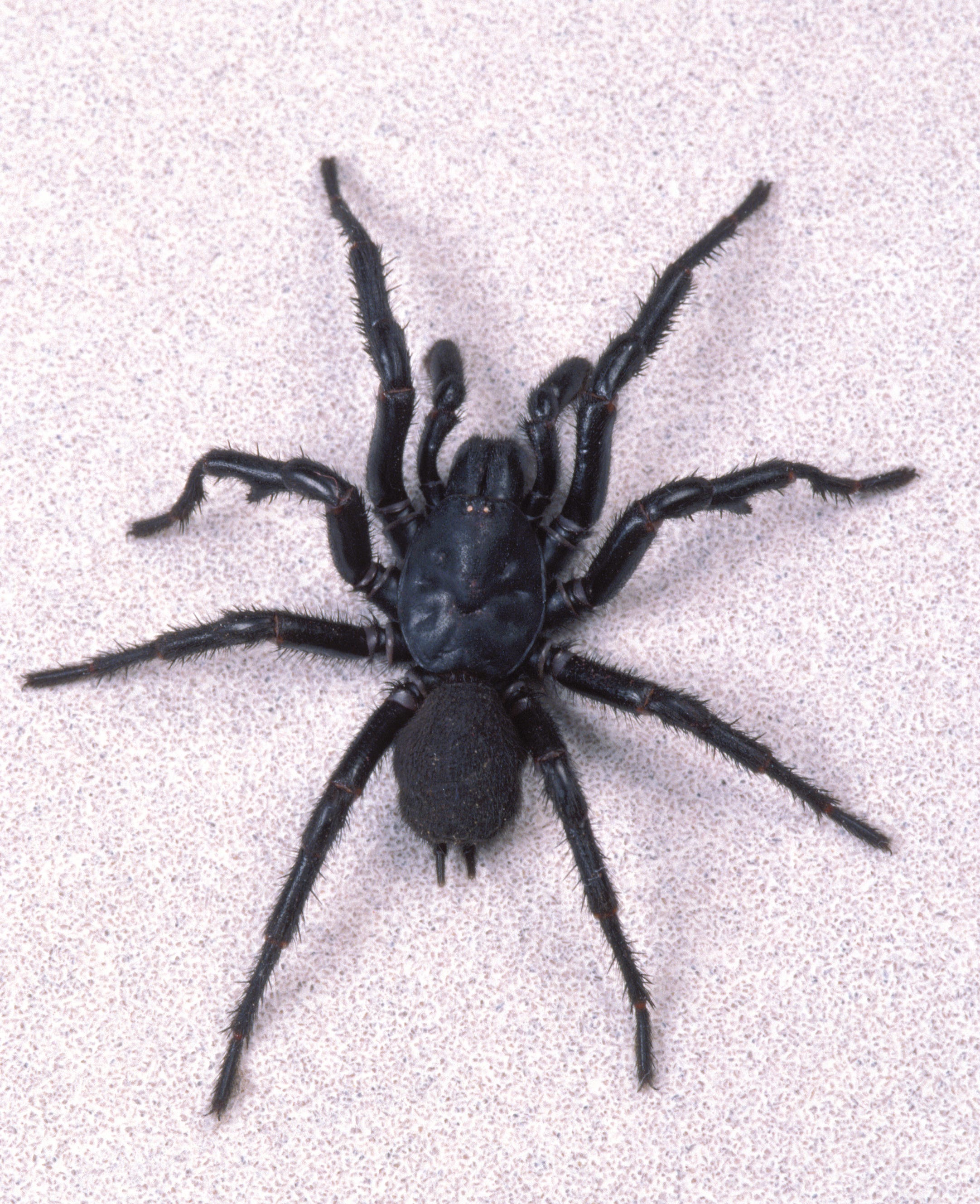
The weird thing is that while the venom is extremely lethal for primates, it’s not effective against most other mammals. Indeed, cats and dogs seem relatively unaffected by the venom from these spiders3. That is really weird.
The venom’s active component is called δ-hexatoxin-Ar1a (δ-HXTX-Ar1a for short). Studies of this venom have shown that it is insecticidal (kills insects) by inhibiting voltage-gated sodium channels4. Voltage-gated sodium channels are crucial proteins that sit in the membranes on the outside of excitable cells. Excitable cells sound cute, but actually they include neurons and muscles- cells that respond to a stimulus and react in response; neurons fire off a signal, muscles contract. These cells respond to a signal by depolarising their membranes slightly, and voltage-gated sodium channels respond to that to amplify the depolarisation. When a signal arrives and slightly depolarises the cell, these proteins open and transport sodium ions across the cell membrane, amplifying the signal. Sodium ions are positively charged, so as they rush into the cell, they reduce the charge difference across the membrane, thus completely depolarising the cell. If these channels are blocked by a venom, for example, then the cell can’t depolarise, nerve signals are not transmitted, and muscles can’t contract. The venom from funnel-webs causes reversible paralysis in insects by blocking these channels so the insects can’t run/fly away, which makes sense as spiders tend to hunt and eat insects4.
What is odd is that the venom causes some effects in mammals too. It causes pain in mice4, but cats and dogs seem insensitive to it. Also interesting is that δ-HXTX-Ar1a is the only one of a bunch of toxins in the venom that affects mammals and is only present in the venom of mature males. Strangely, mature males generally don’t feed, so why are they making δ-HXTX-Ar1a? It’s hypothesised that this venom evolved as a way for spiders to defend against vertebrate predators, such as birds and lizards, by causing pain and prompting avoidance4. Mature males wander about looking for mates and are therefore exposed to predators. This venom evolved to protect the males while they looked for mates.
If you compare the protein sequence of the δ-HXTX-Ar1a toxin with other δ-HXTX toxins in spiders, you can date when this toxin started to evolve, likely 150-200 million years ago4. As primates only arrived in Australia 65-60000 years ago, the defensive role of the toxin evolved long before primates. Something, and it is not yet clear what, has happened in the evolution of primate Voltage-gated sodium channels that has made them especially sensitive to this toxin. The toxin evolving to deter predators, and our channels evolving sensitivity to them, has happened independently, a coincidence. The spiders have not evolved to hunt primates; they just happen to make a toxin that is really bad for primates. When you are twitching, vomiting and producing too much saliva from the effects of your funnel-web bite, you can console yourself that the spider didn’t mean it.
Such coincidences happen in biology all the time. It gives us biologists headaches, but it also demonstrates that we need to be extra careful when thinking about things that seem to be connected. The simplest, most logical, most parsimonious explanation in biology is not necessarily the right one. There is much research needed to clearly and functionally link two co-occurring things in nature. Alternatively, much damage can be done when we discount the possibility that something is a coincidence. The spurious and false link between autism and vaccination seems to be one of these.
Biological (and linguistic) complexity means that coincidences happen all the time. What is even more interesting is that sometimes those coincidences also provide the fuel for evolution. If Sydney Funnel Webs ever get the taste for it, they are pre-adapted to be very effective at hunting humans.
Coincidences happen quite frequently, especially in complex systems. We need to be better at recognising them.
Coincidence, by David Berman

For Mildred Nash

Coincidence. Perhaps coincidence
Explains it all. Why look far out, in deep
For mystical solutions to make sense
Of how a dream disturbed more than my sleep—
A dream in which you sat bolt upright on
A Windsor chair and wore a long blue dress
(Ornamented with a white chiffon)
And on your visage bore a dark distress
And said your dog was dead? When I awoke,
I thought the dream an impetus to phone,
And when I did, the first words that you spoke,
Through sobs, were that your cat had died. Your tone
Was as it had been in my dream, which plain
Coincidence tries too hard to explain.Atkinson, Q.D. and Gray, R.D., 2005. Curious parallels and curious connections—phylogenetic thinking in biology and historical linguistics. Systematic Biology, 54(4), pp.513-526.
Dixon, R. M. W. (1966). “Mbabaram: A Dying Australian Language”. Bulletin of the School of Oriental and African Studies, University of London. 29 (1): 97–121.
https://australian.museum/learn/animals/spiders/funnel-web-spiders-group/
V. Herzig, K. Sunagar, D.T.R. Wilson, S.S. Pineda, M.R. Israel, S. Dutertre, B.S. McFarland, E.A.B. Undheim, W.C. Hodgson, P.F. Alewood, R.J. Lewis, F. Bosmans, I. Vetter, G.F. King, & B.G. Fry, Australian funnel-web spiders evolved human-lethal δ-hexatoxins for defence against vertebrate predators, Proc. Natl. Acad. Sci. U.S.A. 117 (40) 24920-24928, https://doi.org/10.1073/pnas.2004516117 (2020).
Love the poem. Exactly the kind of thing that drives pattern-recognising bipeds crazy!
> It also likes to steal words that it likes from random languages and hold on to them. It’s a bit like the British Museum.
I suppose it's fun to get in a cheap shot at the BM, but this really doesn't make any sense. A language, or language speakers, can't really steal a word like a pickpocket stealing a wallet. The original language users still have that word and it still means whatever it means in that language. It does occasionally happen that a word is taken up by a group of people and used in a way that becomes so common that the original use becomes difficult. But this is not the case with most of the words taken into English from other languages.
As far as the BM goes: perhaps we could be given five examples of things the BM has stolen? I don't mean things in the BM that were stolen by someone else, that probably happened a lot to many of the items in their collection during a long and complicated history: the claim here is that the BM steals things. Name five, please.