
on Kākāpō
and extinction

I was bitten by a kākāpō once. A hefty female called Zephyr took a chunk out of the back of my hand, leaving her with a bloody beak, and me with a scar that I will get out for anyone who wants to see it. Why? Because it’s a privilege to be bitten by a Kākāpō, and something that, when I was a kid, was almost impossible.
If you don’t know about kākāpō, you really, really should. Kākāpō are a species of bird found nowhere else in the world but Aotearoa New Zealand. They are parrots, and so I am sure you are picturing them as a little parakeet thing, or perhaps one of those African Grey parrots.
Ok, take one of those and inflate it…
more…
yep, even more…
rounder…
yes, that’s it. Kākāpō are the world’s heaviest parrot. They would be the world’s biggest, but those big blue macaws have long tails. They are large, flightless, coloured in a million shades of green, and chonky. They are the original, chonky green birds.
Right, you say, big green parrot, whatever. Seen it…
Kākāpō, as noted above, are the only flightless parrot. They are one of only two nocturnal parrots. They are the only parrot with a polygynous lek breeding system. Males, in the breeding season, make a ‘track and bowl system’, sit in it, inflate themselves and make non-directional booming calls that sound like nothing on earth. They are possibly the world’s longest-living birds, with a reported lifespan of 100 years. They have a distinctive smell, which is odd for birds, and they are critically endangered1.
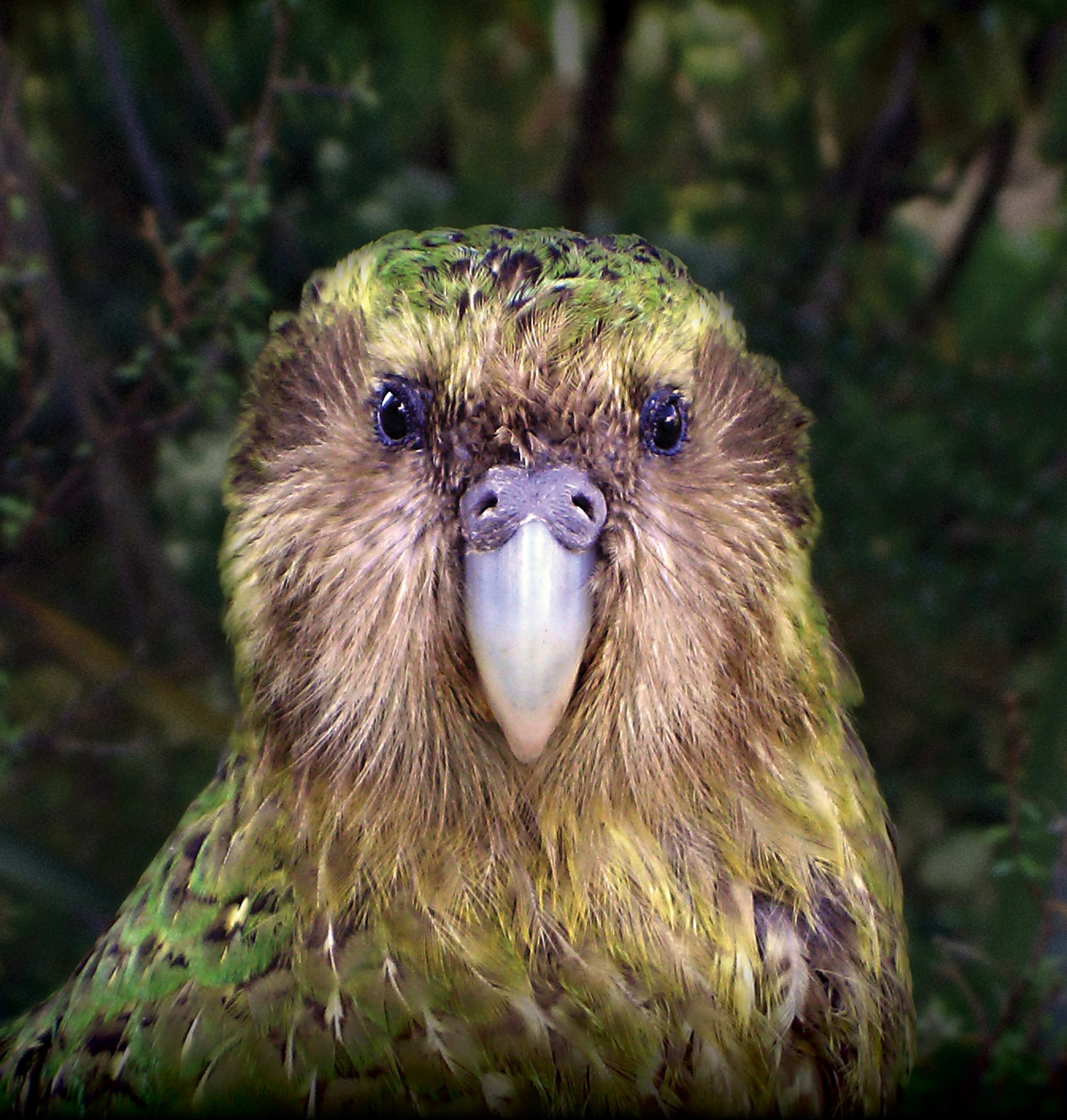
I care about them because when I was a kid, the story was that they were extinct, but didn’t know it. One male was known, given the name Richard Henry (after a pioneering conservationist), who had lived in Fiordland. Fiordland is in the southwest corner of Aotearoa New Zealand. To describe it, it helps to remember that a long fault line runs the length of the South Island of Aotearoa New Zealand. This fault, called the Alpine fault, explains our high mountains and our massive earthquakes. The fault slides off the side of the island just north of Fiordland, leaving a pile of crushed and mangled mountains, sheer cliffs, drowned valleys and deep lakes. This is Fiordland, it’s what Kiwis call ‘rugged country’. It’s steep, unstable, covered in deep, tangled forest, often impassable and unexplored. To add to its charms, the weather is shit, and even if it is nice, it’ll be changing in a couple of minutes.
In this unstable, impassable and spectacular landscape, there was one kākāpō left: Richard Henry. He would boom forlornly in his track and bowl system, hoping for mates, but there weren’t any. He was moved to an offshore island, but the game was up for kākāpō.
What a game though! What was becoming extinct was a lineage of parrots like none other, adapted to an environment found nowhere else. A species that, probably having flown here from Australia, sat down to evolve a whole new way of life for a parrot. It became deeply weird because being weird was what was needed in its new environment. Being brash and opening bins2 like Aussie parrots wasn’t going to work here. Here, being nocturnal and flightless and booming was a better bet. Kākāpō are unique, but they are also, as we all are, descended from the last common ancestor of life on earth- a 4.3 billion year journey. When we talk about the extinction of a species, we tend to think about that species and its environment, but, firstly, these birds are the descendants of billions of years of evolution, the carriers of genes and genetic variation across all that time, and examples of the use of that genetics to do unique and surprising things. I bet dinosaurs would be surprised by the descendants they had, and kākāpō equally so by their antecedents.
When a species goes extinct, this is what we lose. The breaking of a previously unbroken chain of life reaching back into the deepest prehistory of this planet. I know extinction happens all the time in nature, but when it is driven by human negligence or worse, it is a tragedy, an indication that though we think we have inherited the earth (screw those meek), we don’t generally understand it, or cherish it. As an aside, this loss is not recoverable by some overblown biotech company claiming they can resurrect things. There is no backup disk to work from. Extinction is forever.
That is what was happening to all of Richard Henry’s friends. The female kākāpō he was forlornly calling for had been eaten. Kākāpō were once common in this country, in both North and South Islands. But they evolved to cope with a different predator to the ones that humans brought. Kākāpō appear to be adapted to escape from a giant eagle, which was the top predator before humans arrived. Haast’s Eagle3, was the largest eagle to have existed, 10-18 kilos with perhaps a 3-meter wingspan. What do you do when you are being hunted by a giant eagle? You get camouflaged in all the shades of green, you go nocturnal, when eagles don’t fly, and you freeze and do not move when threatened.
None of that works when you are being hunted by human-introduced rats, cats, stoats and people. Smelling weird doesn’t help you either. Freezing when you see a mammalian predator is an invitation to be severely nibbled. Hence Richard Henry’s lonely vigil.
The good news is that, in 1977, a new population of kākāpō, with females, was found on Rakiura (Stewart Island). This population was rapidly discovered to be being eaten by feral cats, and so they, and Richard Henry, were bundled up and transported to offshore islands, including a mainly predator-free island off Rakiura, called Whenua hou.
This last remaining populations didn’t thrive. Whenua hou was not a great place for them as the Rimu, a key food species, didn’t mast there. Rimu masting is linked to kākāpō breeding. Numbers dropped to a low of 51. They were on their way out. Again.
In 1995 however, the Kākāpō recovery programme was established as part of the Department of Conservation (DOC). They moved all the kākāpō off Whenua hou while they exterminated the rats on the island. They implemented and commissioned the best science they could to support kākāpō breeding. They kept out pests, they worried about inbreeding, they moved birds around to improve mating chances, and, slowly, things got better. After the year 2000, numbers started going up; the incredible kākāpō recovery programme team seemed to have sorted out what to do. At the heart of this success was the careful and deliberate implementation of the best science they could find. This was a remarkable demonstration of what care, attention, skill, and knowledge can do, even when the future for these incredible birds looked bleak.
As genomic technologies came on board, a reference genome of kākāpō was developed4, and with funding from DOC and the Genetic Rescue Foundation, and with guardianship from Ngai Tahu, 169 kākāpō, all but two of the entire species, had their genomes sequenced.
This is where my team came in; we analysed that data and learnt a bunch of things. Perhaps the most important being that DOC had managed kākāpō remarkably well, and that inbreeding issues were small5. After an initial mistake, we also discovered that the hero of this lack of inbreeding problems was good old Richard Henry, who had contributed most of the genetic variation in the modern kākāpō population. He did not boom in vain.
Finding stuff out is great, but we aimed to try and fund ways to use genomes to help the species. We developed tools to help manage the population, and examined routes of infection for a disease epidemic that spread through the population6. We tried to turn the complexities of genomics, into actionable outcomes for kākāpō, and tools for use in other endangered species.
This year has been a big year for kākāpō breeding, with over 100 chicks hatched. I am very proud that our genomics work may have been a small part of this success, but prouder still of the kākāpō recovery team, who have put in the hard yards to turn this around. There are, as of today, 235 adult kākāpō, and 91 chicks. Inbreeding is still a problem, but, in my opinion, the more kākāpō made, the more genetic variation will occur. I think we might be O.K. The problem is becoming not how do we keep them alive, but where do we put them? We are running out of suitable, predator-free environments. Perhaps we should just bite the bullet and make all Aotearoa New Zealand predator-free?
Now, this is all great news. But it all depends on funding, on donations and on goodwill. All this is running out. The work we (Genomics Aotearoa) did with kākāpō is now not possible, because the government has said that our funding should go to science that makes money. Saving remarkable species is off the table. Members of our current government have said, in public, that if an endangered species is in the way of a mine or a new road, then it’s goodbye. I cannot reconcile that view with humanity. It appals me that we, as a species, can not see the value of the other species we inhabit this planet with, and should so callously dismiss them.
Zephyr took a chunk out of my hand because I didn’t follow instructions. I was privileged to be on Whenua hou at a time when the transmitters on the birds were being changed. Each bird has its own transmitter, and so we followed Zephyrs until a brilliant DOC ranger caught her, and then asked me to hold her. Instructions were to grab hold of her feet with one hand, with the other hand around her neck and pull so she can’t move her head around to bite you. I was very tentative because I thought I could see the headlines “ Scientist kills treasured kākāpō by pulling off its head”.
Reader, she bit me.
Small price to pay, I reckon!
As are the millions of dollars and millions of hours that have been put in saving this one species
If you want to donate to the amazing Kākāpō Recovery Team, please go here. They are responsible for keeping this incredible bird alive, and what they learn is applied to other species.
You should also follow @digs.bsky.social on Bluesky.
https://en.wikipedia.org/wiki/K%C4%81k%C4%81p%C5%8D
Klump BC, Major RE, Farine DR, Martin JM, Aplin LM. Is bin-opening in cockatoos leading to an innovation arms race with humans? Curr Biol. 2022 Sep 12;32(17):R910-R911. doi: 10.1016/j.cub.2022.08.008. PMID: 36099892.
https://en.wikipedia.org/wiki/Haast’s\_eagle](https://en.wikipedia.org/wiki/Haast’s_eagle)
Rhie A, et al Towards complete and error-free genome assemblies of all vertebrate species. Nature. 2021 Apr;592(7856):737-746. doi: 10.1038/s41586-021-03451-0. Epub 2021 Apr 28. PMID: 33911273; PMCID: PMC8081667.
Guhlin, J., Le Lec, M.F., Wold, J. et al. Species-wide genomics of kākāpō provides tools to accelerate recovery. Nat Ecol Evol 7, 1693–1705 (2023). https://doi.org/10.1038/s41559-023-02165-y
Winter, D.J., Weir, B.S., Glare, T., Rhodes, J., Perrott, J., Fisher, M.C., Stajich, J.E., Digby, A., Dearden, P.K. and Cox, M.P., 2022. A single fungal strain was the unexpected cause of a mass aspergillosis outbreak in the world’s largest and only flightless parrot. Iscience, 25(12).
Kakapo recovery has also benefited from quite high corporate sponsorship. NZAS contributed 4.5m over 25 years, over which time the population went from ~50 to ~125 - an increase of 75 birds @60k each by my calculations plus the other funding. Meridian took over the sponsorship 10 years ago (so NZAS is still paying indirectly!) So the government's been subsidised on this one on various counts.
Peter, excellent, thank you. I have circulated to friends and family in Texas and recommended at my LinkedIn https://www.linkedin.com/in/tony-brenton-rule-839299/ that it be read.
Did you have much to do with Ken McNatty re the link between kakapo's diet and their irregular breeding cycles?