
on the 5th base
and woolly thinking

DNA is, famously, made up of four chemical bases. They have names, but we don’t have to care about that as we call them A, C, G and T. These bases sit in the middle of the double helix-shaped molecule of DNA. When we talk about ‘sequencing DNA’, we are determining the order of those bases. In humans, there are 3.2 billion of them, all in order, running down each of our 23 chromosomes. DNA.
One complication is that DNA is sometimes chemically modified. The most common of those modifications in the human genome is called 5-methyl- C (5-methyl-cytosine). This is a normal C base that has had a methyl group- a simple chemical unit- plonked on it. So in the human genome there are ‘normal’ C bases and modified methyl-C bases. So, there are 5 types of bases. There are actually a few more modifications that we might talk about in a minute.
The important thing about 5-methyl-C and ‘normal’ C is that you can change one to the other. An enzyme, called DNA methyltransferase, can put a methyl group onto a C base, changing it from C to methyl C. Another bunch of enzymes, led by one called Tet1 (Ten-eleven translocation methylcytosine dioxygenase 1 ), can start to take the methyl modification off again, on the way the methyl group is chemically modified, making most of the other modifications I mentioned before.
Thanks for pushing through all the chemical stuff (if you did) because this modification of the C base has become a big thing. You will have heard about it, but you will know it as ‘epigenetics’. Epigenetics is all the rage in human health and aging at the moment. You can find people selling you all kinds of stuff that they claim will improve your epigenetics. But what is it?
The term epigenetics was coined by a guy named Conrad Waddington1, who used it as a way to talk about how genes work in an organism. ‘Epi’ means above, so epigenetics is ‘above genetics’. Waddington defined it as “the branch of biology which studies the causal interactions between genes and their products, which bring the phenotype into being”. What Waddington was talking about was the way that the combination of the genetics of an organism and the environment influences what genes are turned on and off. Those gene regulation processes shape the form of an organism or its response to environmental challenge.
Genes aren’t turned on all the time; they go on and off in ways that are influenced by all kinds of things. Different genes are expressed in different cell types- the differences between kidney and liver cells depend on what genes each type of cell expresses. During embryonic development, an animal embryo goes from undifferentiated cells that can make all the cells of the final adult to differentiated cells that can only make more of themselves. This is gene regulation acting to turn on specific ‘kidney’ or ‘liver’ programmes and turn off other programmes.
We know quite a lot about how these decisions, called cell fate decisions, work, and one day I will write about them because they are very cool, but, in the meantime, let’s just say that cells are pushed into particular cell fates, and, when that happens, they turn on some genes and turn others off. If they are becoming a completely differentiated cell, then those genes that are turned off are normally off forever. These cells can’t go back because the genes required to be something else have been silenced.
Epigenetics, since Waddington, has become a more specialised idea. Now it refers to modifications of DNA, like methyl-C, and modifications of a set of proteins, called histones, that wrap around DNA. Remember, the human genome is 2 meters long. In each tiny cell nucleus in your body, there is a 2-meter length of DNA. Now obviously it has to be wound up and packed in to fit, but in winding up DNA you are going to make some bits of the genome more packed in than others, even making some bits inaccessible.
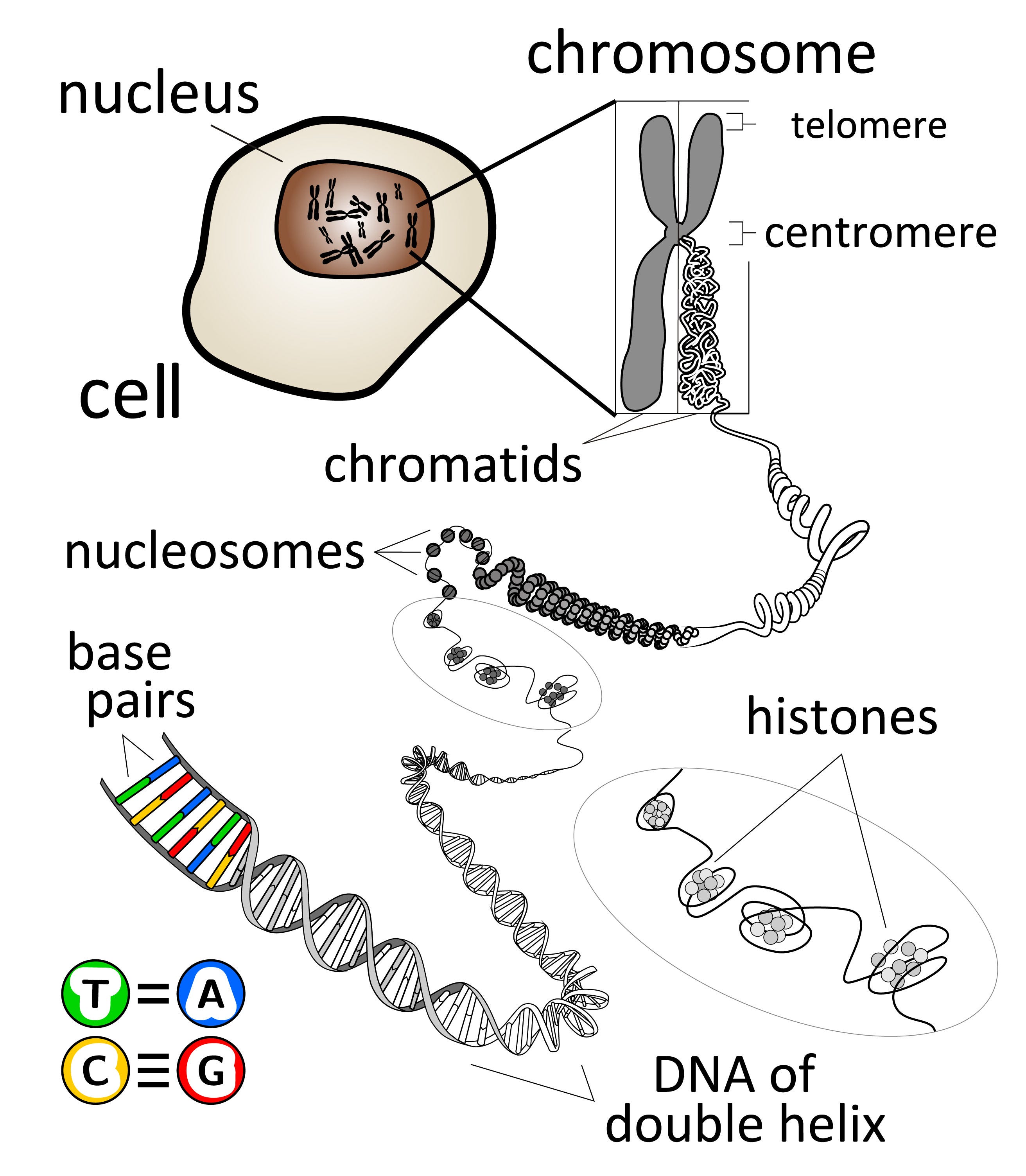
So here we have two processes. One is a gene regulation thing that has to turn on some genes (or bits of DNA) and turn others off. The other is a DNA packing thing, which needs to package up DNA to fit in the nucleus, while still making sure some bits of DNA are accessible so genes can be turned on. At this point, you will not be surprised if I tell you that much of this is the same system. Bits of DNA that are not wanted anymore are often tightly bound up and inaccessible to make RNA, and bits of DNA that are wanted are more relaxed. The modifications on the histones that DNA winds around are key to making bits of DNA inaccessible or accessible, as is 5-methyl-C.
I like to think of this like a library, but one that is very short of space. As a cell travels along the path from undifferentiated to differentiated, it has to open up the bits of the library that it is going to need; books about how to be a liver cell. But as the library is short of space, it has to close down the bits it doesn’t need, all those books on being a kidney cell. These epigenetic mechanisms then help keep the open bits open, and to save space, they close and crush to inaccessibly, the bits that aren’t needed into inaccessibility. The library becomes irreversibly biased to one fate or another, rather like a school library in the Southern States of the US, but instead of ‘anti-wokeness’ being the mechanism, it’s epigenetics.
Biologists can, through some really neat technologies, map where in the genome in a cell the histones are modified2, or methyl-C is present3, and there has been a great deal of work looking at the relationships of this with disease states or other issues.
Epigenetics has been taken up by the pharmaceutical and cosmetics industry, which will sell you nutraceuticals, cosmetics and supplements to improve your ‘epigenetics’. Scientists have spilt much ink arguing about epigenetic mechanisms, and how the environment might influence them, and how that might permanently change what genes you express. Epigenetic mechanisms have been proposed for all kinds of things, including the long-term effects of stress, impacts of poor maternal nutrition and the lingering effects of infection.
Now I am not saying all this is wrong, but I do think we need to pause for a moment and think about some issues.
1) Every cell type in your body has gone along its own journey from undifferentiated to differentiated. Every cell type has its epigenetic marks on histones, and methyl C in different places. Many times, when we talk about changes in epigenetic marks due to some environmental influence, we forget that that change might actually just be a change in the cell types you are seeing. For example, when you get an infection, there are epigenetic changes detectable in your blood. Why? Because an infection triggers the production of different types of white blood cells, all of which have their own epigenetic marks. The shift in epigenetic marks in blood is because the cell types are changing.
2) Ways to specifically change an epigenetic mark experimentally have only just been identified and are not widely used. This means that when we talk about changes in epigenetic marks due to some environmental effect, we are talking about a correlation between an epigenetic mark and the environmental effect because it has been very hard to test a causal connection. Correlation does not equal causation. Lots of things can correlate with other things without there being an underlying mechanism. One of my favourite examples is below.
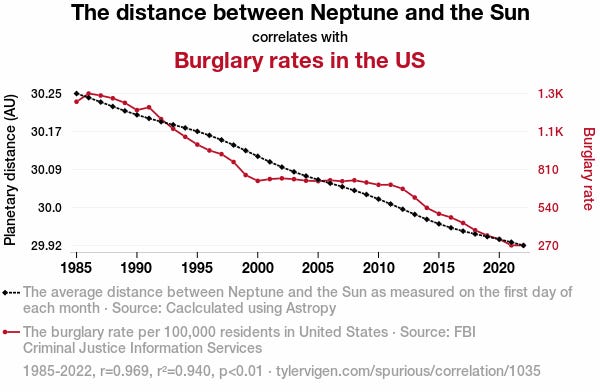
So how do we prove a causal link in biology? Well, that’s hard, but controlled experiments where we modify a bit of biology and see the outcome are the gold standard. Sadly, we have few ways to do that at the moment, at specific sites in the genome, with most epigenetic processes. Technologies have been developed to do this, linking a broken Cas9 enzyme to a methyltransferase4 (if you want to know the details), but not much has been published using this tool. I am really looking forward to lots of careful functional analysis of epigenetic marks, which will allow us to test their effects.
3) When we look at differences between epigenetic marks between people, in the same cell type, the differences we see are much more likely to be the consequences of genetic differences than not5. The genetics of each person seems to predict the epigenetic marks more than each person’s different environmental history. If you think about most epigenetic processes being driven by the process of making different cell types, this makes perfect sense. It doesn’t fit with the idea that epigenetic marks somehow provide a history of environmental exposure.
So when you hear about epigenetics, and particularly when you hear about it as being more important than genetics, or an indication that it overthrows our current ideas of genetics and evolution, please be sceptical. It’s hard to be accurate about actual epigenetic change because of cell types having different signals; we don’t have good tools to understand its function, so we are often studying correlations, and many epigenetic changes are actually the knock-on effects of genetic variation.
Yes, there are interesting things in epigenetics, and yes, because evolution works on what is available, not on what is logical, there will be interesting environmentally triggered epigenetic things, and epigenetic evolution. But remember, what is actually happening most of the time is that the epigenetics is responding to gene regulation. As genes are turned on and off, the epigenetic marks around them change. As your genome responds to all the challenges you face, genes are turned on and off, epigenetic marks change, bits of the genome become more or less accessible. Most of epigenetics is just gene regulation, and most of the time you don’t have to reach for an epigenetic mechanism to explain it.
Many cancers have weird epigenetic changes in their cells, but they also have weird genes being expressed. Those weird epigenetic changes are great tools to help us deal with or identify cancer, but it is a mistake to suggest that those changes are responsible for cancer. It’s important and difficult to distinguish cause from effect in biology.
In my opinion, the field of epigenetics is extremely challenging and, because of a lack of functional tools, is often over-interpreted. Much of this is driven by scientists having the tools to measure epigenetic marks before we had the tools to understand what they do. The current fad in selling you epigenetics-related supplements or cosmetics is equally problematic. We can’t really prove that the epigenetic processes that may be affected by these products have any effect on the genes and their regulation that set up these marks. If in a scientific context we can’t tell you what an epigenetic mark does, there is no way we know when you take your supplement.
Epigenetics may have much to teach us, but please avoid the hype and think critically.
C.H. Waddington Endeavour, 1 (1942), pp. 18-20
Park, P.J., 2009. ChIP–seq: advantages and challenges of a maturing technology. Nature reviews genetics, 10(10), pp.669-680.
Bock, C., 2012. Analysing and interpreting DNA methylation data. Nature Reviews Genetics, 13(10), pp.705-719.
Xiong, T., Meister, G.E., Workman, R.E., Kato, N.C., Spellberg, M.J., Turker, F., Timp, W., Ostermeier, M. and Novina, C.D., 2017. Targeted DNA methylation in human cells using engineered dCas9-methyltransferases. Scientific reports, 7(1), p.6732.
Carja, O., MacIsaac, J.L., Mah, S.M., Henn, B.M., Kobor, M.S., Feldman, M.W. and Fraser, H.B., 2017. Worldwide patterns of human epigenetic variation. Nature Ecology & Evolution, 1(10), pp.1577-1583.
Nice one Peter! And you didn’t mention the buzz word “inflammation” once!
Outstanding - and a useful corrective to the overheated discourse on epigenetics.