
on Flies
and yellow lines

It is an established proverb that “You can catch more flies with honey than with vinegar”.
Many people have a problem with this proverb, because why would you want to catch flies?I have a problem with it, because, for some sorts of flies, you absolutely can catch more flies with vinegar than with honey. That’s why when you open a bottle of wine, you are often surrounded by Drosophila flies- which love a bit of vinegar.
Anyway. I am reminded of this because of a strange event that occurs every year where I live.
Here in Dunedin, we are heading into winter, and the mornings are becoming darker as I walk our old and sufficiently hairy dog on his daily tour of the local smells.
One strange thing that happens is that the seagulls all point in the same direction on the rugby field we walk past- and it’s not to do with the wind. I haven’t worked out what that is about, and when I do i’ll let you know, but, the other strange event is to do with flies.
At this time of the year, as we walk in the semi-darkness, I often get startled by a species of fly buzzing around my head. I don’t think this is a personal hygiene issue, as it only happens in autumn, and even then intermittently.
The flies are quite big ones, which is why I notice them. They buzz at a frequency which is pretty close to that of bees. While I have worked with bees for many years, I am fairly allergic to their stings, and so am hyper-aware of buzzing things that sound like bees around my head.
When I walk the dog, I don’t take him along roads littered with rotting carcasses or open sewage pipes- for obvious reasons. These are the places you might expect to get flies in numbers. Flies also tend to be day flying and don’t like the colder temperatures of either autumn or pre-dawn. And yet, every autumn, in the pre-dawn gloom, these flies come and disturb us (or we come and disturb them).
They don’t bite, they don’t land on me, all they do is buzz around my head a few times and then vanish back into the dark. So as we walk along, I am intermittently bothered by a fly or two, who buzz about and then go away. A few steps on and there is another one.
These intermittent fly flybys happen in two places on our normal walk, one, along the side of a road where there is no footpath. And one, where there is a footpath, and there are a series of wooden posts stuck in the ground separating the roadway and the footpath.
Being of a scientific bent, I have spent some time trying to work out why this happens, rather than writing lectures, and the breakthrough came through the intermittent aspects of the fly attack.
It turns out, the dog and I are only bothered by flies by the side of the road where there are yellow lines. Dashed yellow lines denote no parking on the side of the road in New Zealand, and where there are dashed yellow lines, every time I walk up to, or past, the line, I am bothered by the fly.
So it’s something to do with the lines. But where there are the posts, there are no lines, and yet there are flies.
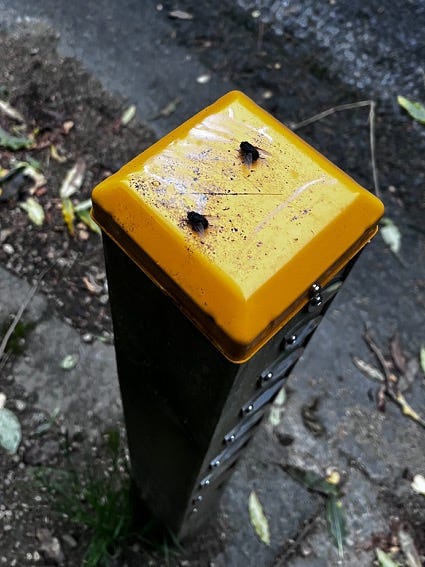
Each post is capped with a little plastic lid- and the plastic lid is… Yellow.
In fact, if you creep up quietly, you can see little groups of flies hanging out on the yellow lids, waiting to be disturbed by me. As I walk past, they swirl up and buzz about in an annoyed fashion. If you can get the dog to stop for long enough, they eventually settle happily back on the yellow lids.
Turns out many, but not all, flies like yellow things. Yellow apparently mimics the colour of pollen, which attracts flies that feed on it. In New Zealand, flies are important pollinators, especially in alpine environments where they are the most common visitors to flowers1, many of which are white with yellow pollen.
If you ask flies what colours they prefer, using coloured bits of cards or fake flowers, those that are pollen feeders tend to like yellow2. Those that don’t feed on pollen don’t really have a colour preference.
Yellow actually seems to be an attractor for many insects and is used in technologies such as those yellow sticky traps that you can buy at a garden store to catch flies and aphids in your greenhouse. The yellow colour acts to attract the insects, while the stickiness is just a glue- no need for an insecticide or a chemical lure- so they don’t really have a use-by date.
Just a quick shout-out to flies- I know they are unpopular, but they are also amazing and important components of life on earth. They don’t just pollinate things, which is very useful; they also do vast amounts of waste disposal. Without flies, we would be buried in the corpses of dead things. Flies perform remarkable and important cleanup services. This clean-up job is even mentioned in the epic of Gilgamesh, the world’s oldest piece of written literature, from 1300-1000 BC, where Gilgamesh recognises it’s time to dispose of the corpse of his best friend Enkidu, when a maggot crawls out of his nose3.
“Enkidu, whom I love deeply,
who went through every hardship with me,
the fate of mankind has overtaken him.
Six days and seven nights I mourned over him
and would not allow him to be buried
until a maggot fell out of his nose.
I was terrified by his appearance(!),
I began to fear death, and so roam the wilderness.”
The Epic of Gilgamesh, Tablet X, Translated by Maureen Gallery Kovacs
The maggot, the larval form of a fly, is just doing its job.
My passing camera phone pictures of the yellow-loving flies are not good enough to identify them. Nor am I really willing to catch one and stick a pin through it so I can look more closely, so I don’t know what species these yellow-loving flies are. But I am charmed by the thought that they are hanging out with their friends on yellow things, perhaps waiting for sunrise and the warmth required to allow them to set off to find new things to pollinate.
Who knew that Coldplay were really thinking about providing entertainment for flies when they sang:
“I drew a line
I drew a line for you
Oh, what a thing to do
And it was all yellow”
Coldplay, Yellow, 2000
Primack RB 1983 . Insect pollination in the New Zealand mountain flora . New Zealand Journal of Botany 21 : 317 – 333 . doi: 10.1080/0028825X.1983.10428561
Crossley, E.G., Forster, C.Y., Latty, T. and White, T.E., 2025. Picky or Pragmatic? Innate Colour Preferences in Three Pollinating Fly Species. Ethology, 131(12), pp.303-312.
The Epic of Gilgamesh, Translated by Maureen Gallery Kovacs, Electronic Edition by Wolf Carnahan, I998